
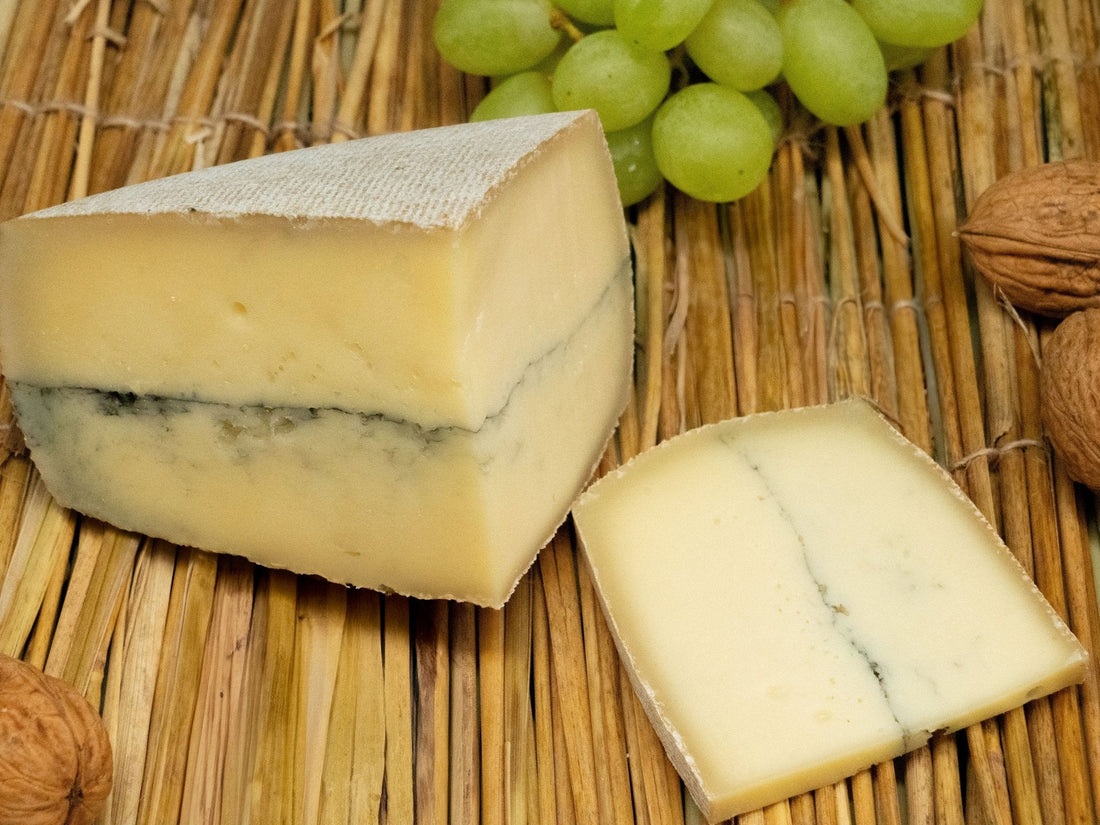
Raw milk cheese fascinates as much as it raises questions. A treasure of French terroir for some, a reason for caution for others, it deserves time to be understood. In this guide, we explain what it really is: how it is made, its benefits, how it differs from pasteurised milk cheese — and, with all due honesty, the precautions to know.
Definition: What Is Raw Milk Cheese?
A raw milk cheese is a cheese made from milk that has not been heat-treated (pasteurised). Raw milk keeps all its natural bacterial flora, its enzymes and its living micro-organisms, which play an essential role in turning milk into cheese. It is this microbial life that creates the aromatic complexity, unique texture and distinctive character of each cheese.
In France, raw milk cheese is a centuries-old tradition. For hundreds of years, cheesemakers have worked with raw milk to create gems such as Roquefort, Comté, Reblochon and Crottin de Chavignol. These cheeses tell the story of their terroirs: the pastures, the seasons, the local traditions.
Raw milk vs pasteurised milk: the basics
Raw milk comes straight from milking. It contains millions of natural bacteria (lactobacilli, streptococci and so on) living in balance. Pasteurised milk, on the other hand, has been heated to 63°C for 30 minutes (low-temperature pasteurisation) or to 72°C for 15 seconds (high-temperature pasteurisation). This heat treatment kills most bacteria, including the good ones.
Raw, thermised, pasteurised: three kinds of milk
Low or high, pasteurisation has the same aim: to destroy potential pathogens (Listeria, E. coli, Salmonella), and with them most of the natural flora. Between the two worlds, some cheesemakers use thermised milk, heated less strongly, which keeps part of its ferments; thermisation is not pasteurisation and does not, on its own, guarantee microbiological safety. For raw milk cheese, the milk is not heated at all: safety relies on the quality of the milk, hygiene during production and ripening.
Why use raw milk for cheese?
Because raw milk is alive. The natural bacteria in raw milk turn lactose into lactic acid, create complex flavours and develop subtle aromas. Without this living flora, cheese would be flat and lack character. Raw milk is the signature of the terroir in every mouthful.
How Raw Milk Cheese Is Made
Making raw milk cheese is a craft that takes patience, know-how and respect for nature. Here are the key stages.
Collecting the milk and its quality
It all starts on the farm. Raw milk must be of impeccable quality: hygienic milking, rapid cooling (to 4°C), transport in a refrigerated tanker. Cheesemakers who work with raw milk choose dairy farmers they trust, often small farms where the cows graze freely. The quality of the raw milk determines the quality of the final cheese.
Adding rennet and coagulation
The raw milk arrives at the dairy. The cheesemaker pours it into a large vat and adds rennet (a natural enzyme that makes milk coagulate). Within a few hours, the milk turns into a soft white curd. This is the magic of raw milk: the natural bacteria are already starting to work and create flavour.
Cutting the curd and draining
The curd is cut into small grains with a tool called a curd knife. This releases the whey. The curd grains drain slowly and naturally. The slower the draining, the creamier the cheese. The faster it is, the drier and firmer the cheese will be.
Moulding and salting
The drained curd is poured into moulds. The cheese takes its shape: cylinder, square, pyramid. After a few hours, the cheese is taken out of the mould and salted. Salt plays two roles: it preserves the cheese and creates a rind.
Ripening and the development of aromas
This is the longest and most important stage. The cheese rests in a cellar at a controlled temperature and humidity. For weeks or months, the bacteria in the raw milk carry on working: they create flavours, develop aromas and transform the texture. It is during ripening that raw milk cheese truly comes alive.
Key difference: the role of ripening
In Europe, no minimum ripening period is imposed by law on raw milk cheeses: each appellation's specification sets its own (4 months minimum for Comté, for example). The "60-day" rule you sometimes read about is American. What is true is that long ripening, in a hard, acidic and dry paste, makes life difficult for pathogenic bacteria: that is why cooked pressed raw milk cheeses carry the lowest risk.
Raw Milk Cheese vs Pasteurised Milk Cheese
Pasteurisation: what is it?
Pasteurisation is a heat treatment that kills bacteria. There are two methods:
- Low-temperature pasteurisation (63°C, 30 min): a slow method, used for some cheeses
- High-temperature pasteurisation (72°C, 15 sec): a fast method, the most common; both eliminate almost all bacteria
Pasteurisation makes milk "safer" by eliminating potential pathogens. But it also eliminates the good bacteria that create flavour and complexity.
Impact on taste and aromas
This is the most obvious difference. A pasteurised milk cheese tastes flatter and more neutral. The complex aromas of raw milk disappear. A pasteurised Comté will never have the depth of a raw milk Comté. A pasteurised Roquefort loses its personality.
Why? Because the natural bacteria in raw milk create unique aromatic compounds. Without them, the cheese is technically correct, but emotionally empty.
Impact on texture and keeping
Pasteurised milk produces more uniform, more predictable cheeses. The texture is often smoother and less "alive". They keep longer (the cheese no longer changes after ripening), but they are also less interesting.
Raw milk produces cheeses that evolve and change over time. A raw milk Comté at 12 months is not the same as at 24 months. It is alive.
Comparison table: raw vs pasteurised milk
| Criterion | Raw milk | Pasteurised milk |
|---|---|---|
| Bacterial flora | Natural, living | Reduced or eliminated |
| Taste | Complex, nuanced, terroir | Flat, neutral, uniform |
| Aromas | Deep, evolving | Simple, stable |
| Texture | Living, changing | Smooth, predictable |
| Ripening | Set by each appellation | Variable |
| Keeping | Evolving | Stable |
| Cost | Higher | Lower |
| Safety | Hygiene, controls and ripening | Pasteurisation and controls |
Why do cheesemakers prefer raw milk?
Because it is a challenge. Because it is alive. Because every raw milk cheese is unique and carries its terroir. A cheesemaker who works with raw milk is an artisan, not a technician. They listen to the milk, respect the seasons and let nature express itself.
Nutritional and Flavour Benefits of Raw Milk
Bacterial richness and natural flora
Raw milk contains billions of beneficial bacteria: lactobacilli, streptococci, bifidobacteria. These bacteria survive cheesemaking and end up in the finished product. Their possible role in digestion and gut health is still being researched.
Vitamins and minerals preserved
Pasteurisation slightly reduces some heat-sensitive vitamins (notably vitamin B12 and folic acid); raw milk keeps them intact. Minerals (calcium, phosphorus, zinc) are not affected by heat: on this point, raw and pasteurised milk are equal.
Aromatic depth and complexity of flavour
The bacteria in raw milk create complex aromatic compounds: volatile fatty acids, esters, aldehydes. These compounds give the cheese its personality. A raw milk Roquefort has notes of hazelnut, mushroom and undergrowth. A raw milk Comté has notes of caramel, walnut and honey. It is the signature of the terroir.
Digestibility and lactic ferments
The lactic ferments in raw milk turn lactose into lactic acid. This makes the cheese easier to digest for people who are sensitive to lactose. Raw milk cheeses, especially long-ripened hard cheeses, contain very little lactose.
Terroir expressed in every cheese
This is the most poetic benefit. Raw milk reflects the terroir: the grass the cows eat, the seasons, the climate, local tradition. A raw milk Crottin de Chavignol tells the story of the Loire. A raw milk Roquefort tells the story of the Causses. Every cheese is unique and inimitable.
Food Safety: Essential Precautions
This is the most important part of this guide. We owe you complete transparency here: raw milk cheese is a pleasure, but one to be enjoyed with full knowledge of the facts.
Potential risks and at-risk groups
Raw milk can contain potential pathogens: Listeria monocytogenes, E. coli O157:H7, Salmonella, Campylobacter. These bacteria can cause serious infections, particularly in vulnerable people.
The at-risk groups are:
- Pregnant women
- Children under 5
- Older people (over 65)
- People with weakened immune systems (HIV, chemotherapy, transplants, etc.)
For these groups, raw milk cheeses carry an increased risk of listeriosis, a potentially serious infection.
Pregnant women and raw milk cheese
Official recommendation (ANSES): pregnant women should avoid raw milk cheeses, particularly soft cheeses (Camembert, Brie, fresh goat's cheese) and uncooked pressed cheeses (Reblochon, Tomme, Morbier). These cheeses provide a favourable environment for Listeria.
Why? Listeria can cross the placenta and cause miscarriage, premature birth or a serious infection in the newborn.
Cheeses allowed for pregnant women: cooked pressed cheeses, even made with raw milk (Comté, Beaufort, Emmental, Gruyère), with the rind removed: their heated curd and hard, dry paste greatly limit the risk of Listeria. Other pressed cheeses made with pasteurised milk (gouda, mimolette) are not ruled out by ANSES, but the more cautious Swiss authority (FSVO) advises against semi-hard cheeses: remove the rind and favour cooked pressed cheeses. Soft cheeses, even pasteurised, remain inadvisable.
Advice: if in doubt, consult a doctor or midwife. All the rules, family by family, are in our guide Cheese and pregnancy: which ones are allowed.
Children and raw milk cheese
Official recommendation (ANSES): children under 5 should avoid raw milk cheeses, with the exception of cooked pressed cheeses (Comté, Beaufort, Emmental).
Why? Young children's immune systems are not yet mature. They are more vulnerable to infections.
Advice: introduce other raw milk cheeses gradually from the age of 5-6.
People with weakened immune systems
Official recommendation (ANSES): people with weakened immune systems (HIV, chemotherapy, transplants, long-term corticosteroid treatment) should avoid all raw milk cheeses, including hard cheeses.
Why? Their immune system cannot fight off infections. The risk of serious listeriosis is high.
Advice: consult a doctor before eating raw milk cheeses.
Ripening: a safety factor
This is a key point. Long ripening reduces the risk from pathogens, without eliminating it, through:
- Acidity: the pH drops, creating an environment hostile to pathogenic bacteria
- Dryness: water evaporates, reducing the moisture pathogens need
- Bacterial competition: the good bacteria in raw milk limit the growth of pathogens
From safest to most sensitive: cooked pressed cheeses ripened for several months (Comté, Beaufort, Emmental) · uncooked pressed cheeses (Reblochon, Tomme), ripened for a few weeks · soft cheeses and fresh goat's cheeses (Camembert, Brie), with the highest risk.
Health controls and official standards
In France, raw milk cheeses are subject to strict health controls:
- HACCP standards: hazard analysis and critical control points
- Microbiological testing: regular tests to detect pathogens
- Traceability: every batch is traced from farm to sale
- AOP/AOC certification: raw milk AOP cheeses must follow strict specifications, checked by INAO
Good practice for storage and eating
On delivery: check that the cheese arrives vacuum-packed or well wrapped, check the use-by date and put it in the fridge straight away (between 4 and 8°C).
During storage: keep the cheese in its original packaging for as long as possible; once opened, wrap it in cheese paper or a damp cloth; avoid cling film (cheese needs to breathe). Keeps for: 2–3 weeks after opening.
Before eating: take the cheese out of the fridge 30–45 minutes before tasting, check its appearance and smell (discard if there is unusual mould or an unpleasant smell) and eat it within the recommended time.
Examples of French Raw Milk Cheeses
Raw milk ewe's cheeses
Roquefort is the king of raw milk ewe's cheeses. Made in the Causses of the Massif Central, Roquefort is a blue cheese, ripened in natural caves, with veins of blue mould (Penicillium roqueforti). Its flavour is powerful and salty, with notes of mushroom and undergrowth.
- Ossau-Iraty (Pyrenees): pressed cheese, nutty flavour, ripened for a minimum of 80 to 120 days depending on the size
- Manchego (Spain, but a benchmark): pressed cheese, caramel flavour, ripened for a minimum of 30 to 60 days depending on the size, often much longer
- Pecorino Romano (Italy, but a benchmark): hard cheese, sharp flavour, ripened for at least 5 months
Raw milk goat's cheeses
The Loire is the home of raw milk goat's cheeses. Crottin de Chavignol is an emblematic AOP: small and round, fresh or ripened, with a tangy, floral flavour.
- Valençay (Loire): ash-coated pyramid, creamy paste, herbaceous flavour
- Selles-sur-Cher (Loire): ash-coated disc, fine creamy paste, nutty flavour
- Picodon (Drôme/Ardèche): small and round, intense flavour, short ripening
Raw milk washed-rind cow's cheeses
Washed-rind cheeses are the most expressive family of raw milk cheeses. Époisses AOP (Burgundy), washed with marc brandy, leads the way: a powerful smell, a melting paste and a taste much milder than you might imagine. In the same spirit are Munster (Alsace), which exists in a raw milk version, and Reblochon (Savoie), always made with raw milk.
Raw milk cow's cheeses (Savoie and Jura)
Savoie and the Jura are home to the great raw milk mountain cheeses. Comté, the Jura AOP, is the best known: a cooked pressed cheese, ripened for at least 4 months and often much longer, with notes of caramel, hazelnut and honey. It is a complex, living cheese that tells the story of the Jura mountains — a region that also produces other specialities such as cancoillotte, the melted cheese from Franche-Comté.
- Beaufort (Savoie): cooked pressed cheese, ripened for at least 5 months, rich, fruity flavour
- Reblochon (Savoie): uncooked pressed cheese, ripened for a few weeks, creamy, fruity flavour
- Emmental de Savoie: cooked pressed cheese, ripened for at least 75 days, mild, nutty flavour
Raw milk blue cheeses
Beyond Roquefort, which is always made with raw milk, other blues exist in a raw milk version:
- Bleu d'Auvergne (Auvergne): ripened for at least 4 weeks, powerful flavour
- Fourme de Montbrison (Loire): ripened for about a month, mild flavour
Frequently Asked Questions (FAQ)
Can I eat raw milk cheese if I am pregnant?
No, it is recommended to avoid raw milk cheeses during pregnancy, particularly soft cheeses (Camembert, Brie, fresh goat's cheese) and uncooked pressed cheeses such as Reblochon. These cheeses may contain Listeria, a bacterium that can cross the placenta and cause miscarriage or a serious infection in the newborn. Cooked pressed cheeses, even made with raw milk (Comté, Beaufort, Emmental, Gruyère), are allowed during pregnancy, without the rind. Other pasteurised pressed cheeses are not ruled out by ANSES, but the Swiss FSVO advises against them. See our guide to cheese and pregnancy. If in doubt, consult your doctor or midwife.
At what age can my child eat raw milk cheese?
Children under 5 should avoid raw milk cheeses, particularly soft cheeses. From the age of 5-6, you can gradually introduce long-ripened hard raw milk cheeses (Comté, Beaufort, Emmental), in small amounts, watching for any allergic or digestive reaction.
What is the difference in taste between a raw milk cheese and a pasteurised milk cheese?
The difference is major. A raw milk cheese has a complex, nuanced taste, with deep aromas that reflect the terroir — a 12-month raw milk Comté develops notes of caramel, hazelnut, honey and undergrowth. A pasteurised milk cheese tastes flatter, more neutral and more predictable. The natural bacteria in raw milk create unique aromatic compounds; without them, the cheese is technically correct, but emotionally empty. Our advice: taste both and decide according to your preferences.
How should you store raw milk cheese?
On delivery, put it in the fridge straight away (between 4 and 8°C). Keep it in its original packaging for as long as possible; once opened, wrap it in cheese paper or a damp cloth and avoid cling film. Keeps for: 2–3 weeks after opening. Take it out of the fridge 30–45 minutes before tasting. At La Dent du Chat, our cheeses arrive vacuum-packed, which keeps them fresh for longer.
Is raw milk cheese safer than pasteurised milk cheese?
The answer is nuanced. For a healthy adult, raw milk cheeses made in line with hygiene rules can generally be eaten without problems, and long-ripened cooked pressed cheeses (Comté, Beaufort, Emmental) carry the lowest risk. The risk is never zero, however, and it is higher for soft cheeses. For vulnerable groups (pregnant women, children under 5, older people, people with weakened immune systems), raw milk cheeses should be avoided unless a doctor advises otherwise, with the exception of cooked pressed cheeses, in line with ANSES recommendations.
Explore our Raw Milk Cheeses
From theory to tasting is only one step — and a vacuum-packed delivery in 1 to 3 days.
Official Sources
- Agriculture.gouv.fr — Regulations on raw milk cheeses, AOP specifications (in French)
- ANSES — What is listeriosis and how to protect yourself? Recommendations for vulnerable groups (in French)
- INAO — AOP/AOC specifications, certification of raw milk cheeses (in French)
- Fromagesaulaitcru.fr — Website dedicated to raw milk cheeses (in French)
- EFSA — European Food Safety Authority: recommendations and epidemiological studies on health risks