
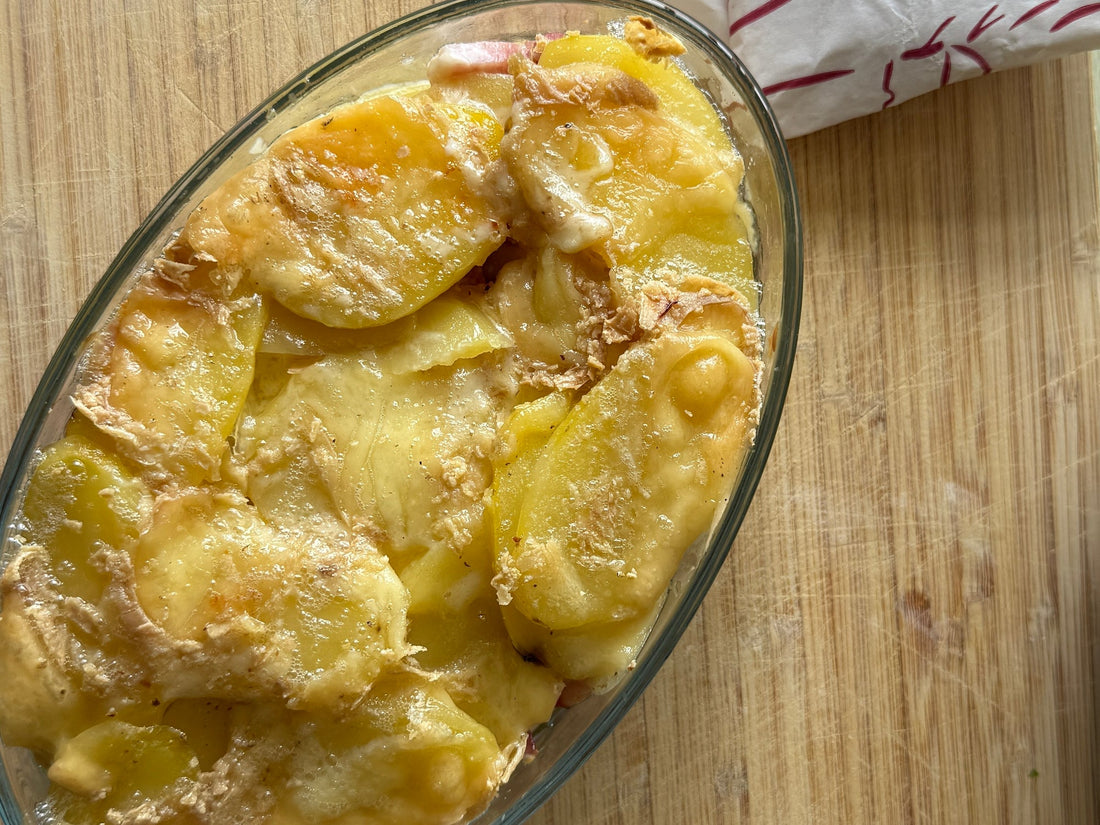
- The Alsatian tartiflette: sliced potatoes, lardons, crème fraîche and farmhouse Munster sliced with its rind.
- Munster melts in three minutes: lay it in slices between the layers and on top, never grated.
- Potato slices par-cooked for 10 minutes, no longer: they finish cooking in the oven.
- For 4: 1 kg potatoes, one 350 g Munster, 200 g lardons, 20 cl crème fraîche.
- Oven at 200 °C, 25 minutes. A pinch of cumin to stay in Alsace.
"Munster is the cheese that smells strong and tastes mild. In the oven, it becomes a sauce."
Everyone knows tartiflette with Reblochon. Alsace has its own answer: potato gratin with Munster, sometimes called munstiflette. The same comforting base of potatoes, lardons and cream, but a cheese that changes everything. Munster has a powerful nose and a surprisingly mild paste, creamy, almost sweet once melted.
It's the dish of autumn evenings in the Vosges, served with a salad and a glass of Riesling or Pinot Gris. It takes 45 minutes, with no technique required, and wins over even those who fear Munster: the heat softens its character and leaves only the meltingness.
This version uses a raw milk farmhouse Munster, sliced with its rind. We've got everything you need to treat yourself!
Ingredients for 4
Preparation: 20 min — Cooking: 35 min

Potatoes, lardons and Munster: the base is simple.
- 1 kg waxy potatoes (Charlotte, Amandine, Nicola)
- 1 farmhouse Munster of about 350 g, made with raw milk
- 200 g smoked lardons
- 20 cl crème fraîche
- Freshly ground pepper
- A pinch of nutmeg
- Salt, sparingly
Optional:
- 1 brown onion, sliced and softened in butter, to slip between the layers
- 1 teaspoon cumin seeds, the classic Alsatian pairing for Munster
- 5 cl Alsace white wine to loosen the cream
The recipe step by step
1. Peel and slice the potatoes
Peel the potatoes and cut them into even 5 mm slices. A mandoline helps, but a good knife is enough.

Peeling with a vegetable peeler.
2. Par-cook the slices
Drop the slices into a pan of boiling salted water and cook for 8 to 10 minutes: they should be tender but still firm, with slight resistance at the tip of a knife. Drain carefully and leave to cool slightly.
They will finish cooking in the oven in the cream and cheese. Overcooked now, they fall apart when you assemble the dish.

Even slices, lardons ready to fry.
3. Fry the lardons
In a dry frying pan, brown the lardons for 5 minutes over a high heat. They should be golden, not crisp. Drain them on kitchen paper.

Dry pan, high heat, 5 minutes.

Everything ready for assembly.
4. Slice the Munster
Preheat the oven to 200 °C. Cut the Munster into 5 mm slices, keeping the rind on: it melts with the rest and concentrates the flavour. A very ripe Munster slices more easily straight from the fridge.

In slices, rind and all. Never grated.
5. Assemble the gratin
In a buttered gratin dish, lay a first layer of potato slices. Scatter over half the lardons, add a few slices of Munster, then spoon over half the crème fraîche. Season with pepper and nutmeg.

Potatoes, lardons, Munster, crème fraîche. Then repeat.
Repeat: potato slices, the rest of the lardons, the rest of the crème fraîche. Finish with the slices of Munster covering the whole surface, side by side. Season with pepper and, if you like, sprinkle with cumin.

The final layer: Munster edge to edge.
6. Into the oven
Bake for 25 minutes at 200 °C, until the Munster has melted, browned in places, and the cream is bubbling at the edges. Munster melts very quickly: keep an eye on it for the last 5 minutes so it doesn't burn.

Into the oven, 200 °C, 25 minutes.
Leave to rest for 5 minutes before serving: the cream and cheese come together, and the gratin holds on the spoon.

Golden, melting, and that smell of hot Munster all through the kitchen.
Serve piping hot, with a green salad with a punchy vinaigrette and a slice of country bread.
Our tips for a perfect gratin
Munster isn't for grating
Its paste is too soft for a grater and melts in a few minutes. Slice it with the rind and lay the slices flat. They melt into an even layer instead of clumping.
The rind is edible
Munster's orange rind is washed with salted water during maturing. It carries the aroma; it melts in the oven and adds flavour. Don't remove it, unless you're cooking for very reluctant guests.
Cumin, the Alsatian pairing
In Alsace, Munster is served with cumin seeds (actually caraway, but everyone calls it cumin). A pinch over the gratin before baking completely changes the dish: warmer, more fragrant, more Alsatian.
Go easy on the salt
Smoked lardons, a salt-washed rind, crème fraîche: the gratin seasons itself. Lightly salt the potato cooking water, and that's it.
Lighter version
Replace the crème fraîche with 15 cl whole milk and a splash of white wine. The gratin will be less rich, but the Munster still makes the sauce.
Vegetarian version
Without lardons, slip an onion softened in butter and a few sautéed mushrooms between the layers. The cumin then becomes essential.
Munster, the cheese people judge too quickly
Munster is an AOP cheese from the Vosges, made on both sides of the mountains: on the Alsace side it's called munster, on the Lorraine side géromé. Soft cheese, washed rind, cow's milk, matured for at least 21 days. Its powerful smell comes from the rind; the paste itself is mild, milky, almost sweet.
Farmhouse Munster is made on the farm with the raw milk of a single herd, often Vosgienne cows. It has a longer finish and a runnier texture than the dairy-made version. It's the one you want for this gratin: it melts better and its flavour stands up to the lardons.
Choose a Munster that is supple to the touch, with an orange, slightly moist rind and no smell of ammonia. Ours comes from the Schuster cheese dairy in the Vosges. And to find out where it belongs on a cheese platter, we explain everything.
Pregnancy: raw-milk Munster is a soft washed-rind cheese; serve the gratin piping hot, bubbling right through, and if in doubt ask your doctor or midwife for advice. The full guidelines are in our guide cheese and pregnancy.
FAQ
Should you remove the rind from the Munster?
No. The washed rind is edible, melts in the oven and concentrates the flavour. Only remove it if you're cooking for guests who are genuinely wary of Munster.
How much Munster for 4 people?
One 350 g Munster for 1 kg of potatoes. If you only have a large 500 g Munster, use two thirds of it and keep the rest for the cheese platter.
Can you make the gratin in advance?
Yes. Assemble the gratin the day before without the final layer of Munster, cover with cling film and keep in the fridge. When ready to serve, add the slices and bake for 30 minutes instead of 25.
Will the gratin smell very strong?
While it bakes, yes: the smell of hot Munster is unmistakable. On the plate, much less so: the heat mellows the cheese and leaves only the meltingness and the milky flavour. It's the ideal dish for winning over sceptics.
Which wine goes with a Munster gratin?
An Alsace white: Riesling for freshness, Pinot Gris or Gewürztraminer to match the power of the cheese. An Alsatian lager also works very well.
Can you freeze the gratin?
Not recommended: the crème fraîche and Munster separate when thawed. Leftovers keep for 2 days in the fridge and reheat in 15 minutes in the oven at 160 °C.
The Munster you need
Raw milk farmhouse Munster AOP from the Schuster cheese dairy, selected in the Vosges and delivered vacuum-packed in 1 to 3 days in Belgium, France and Luxembourg.
Useful sources
- INAO — register of protected designations of origin, Munster or Munster-Géromé (in French)
- French Ministry of Agriculture — precautions with raw milk cheeses (in French)