
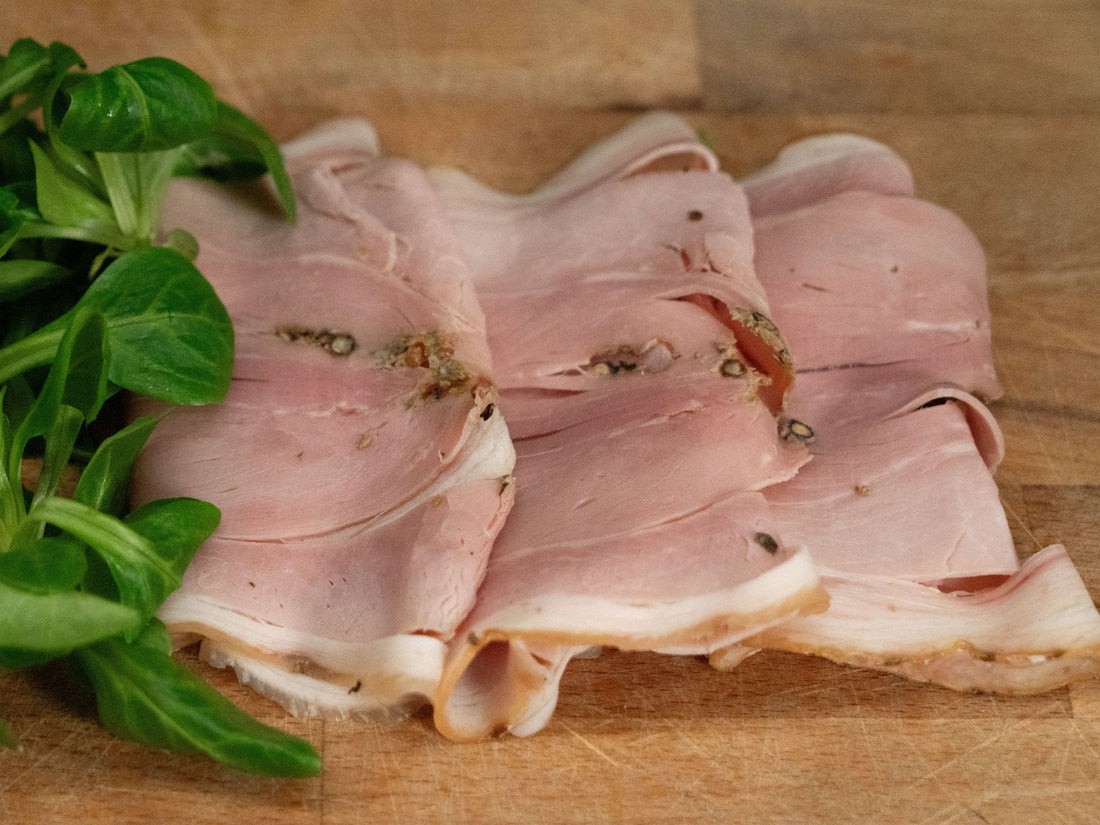
Prosciutto cotto is Italy's cooked ham: a leg of pork brined and then slowly cooked, with pink, fragrant slices. Here is how it is made, how to read its label and what sets it apart from everyday cooked ham.
- “Prosciutto cotto” means cooked ham; “prosciutto crudo”, cured ham.
- It is made from the leg of pork, brined and then slowly cooked.
- Italian law distinguishes three categories: cotto, scelto and alta qualità, from the moistest to the most demanding.
- It is eaten cold, in slices, in a panini or on a pizza straight out of the oven.
- Once opened, it keeps for 4 to 5 days in the fridge.
What is prosciutto cotto?
In Italian, prosciutto means ham, the leg of the pig. Prosciutto cotto is cooked ham, as opposed to prosciutto crudo, dry-cured ham such as Parma. The leg is boned, brined with aromatics, put into a mould and then slowly cooked, often by steaming.
A good prosciutto cotto has pale pink, tender slices in which you can make out the muscles of the leg. Its flavour is mild, slightly sweet, scented by the aromatics in the brine. Some are prepared with herbs and spices, which mark the surface and flavour the slice.

Cotto, scelto, alta qualità: how to read the label
In Italy, a 2005 decree classifies cooked ham into three categories. The main criterion is the moisture content of the defatted meat: the lower it is, the less added water the ham contains.
| Category | Maximum moisture | What it means |
|---|---|---|
| Prosciutto cotto | 82% | The basic cooked ham. Several ingredients and additives are permitted. |
| Prosciutto cotto scelto | 79.5% | Firmer. At least three of the four muscles of the leg must be visible when cut. |
| Prosciutto cotto di alta qualità | 76.5% | The most demanding category: sugars limited to 1.5%, restricted list of ingredients. |
Prosciutto cotto, everyday cooked ham, prosciutto crudo: the differences
- Prosciutto cotto or everyday cooked ham? Both are cooked hams. The difference lies in the recipe: a good Italian cotto is made from a whole leg, with little brine and slow cooking. The slices are tastier and less watery than reformed cooked ham.
- Prosciutto cotto or crudo? Cotto is cooked, mild and tender. Crudo, like Parma ham, is raw, salted and dried for several months: it is saltier and more melt-in-the-mouth.
- Prosciutto cotto or speck? Speck is a cured ham, spiced and smoked. Everything is explained in our speck guide.
How to eat prosciutto cotto
- In a panini or focaccia, with mozzarella or burrata.
- On a pizza, added as it comes out of the oven so that it stays tender.
- Wrapped around grissini, on a board of Italian charcuterie.
- With grilled smoked scamorza, for a hot sandwich.
- In baked pasta or a gratin, diced.

How to store prosciutto cotto
In the fridge, between 0 and 4 °C. If vacuum-packed, observe the date shown. Once opened or sliced, eat it within 4 to 5 days, wrapped in food paper.
FAQ
What is prosciutto cotto?
It is Italian cooked ham: a boned leg of pork, brined with aromatics, then slowly cooked. Prosciutto cotto means cooked ham, as opposed to prosciutto crudo, cured ham.
What is the difference between prosciutto cotto and everyday cooked ham?
Both are cooked hams. A good prosciutto cotto is made from a whole leg, with little brine and slow cooking: its slices are tastier and less watery than reformed cooked ham.
What does “alta qualità” mean on a prosciutto cotto?
It is the most demanding category under Italian law: maximum moisture of 76.5%, sugars limited to 1.5% and a restricted list of ingredients. Next come “scelto” and then plain prosciutto cotto.
Is prosciutto cotto eaten hot?
It is mostly eaten cold, in slices. It also stands up to heat: on a pizza straight out of the oven, in a toasted panini or in baked pasta.
How should prosciutto cotto be stored?
In the fridge between 0 and 4 °C. Once opened, eat within 4 to 5 days.
Prosciutto cotto, sliced in Ixelles
Our prosciutto cotto with herbs and spices, with the mozzarella and burrata to go with it. Delivered vacuum-packed in 1 to 3 days in Belgium, France and Luxembourg.