
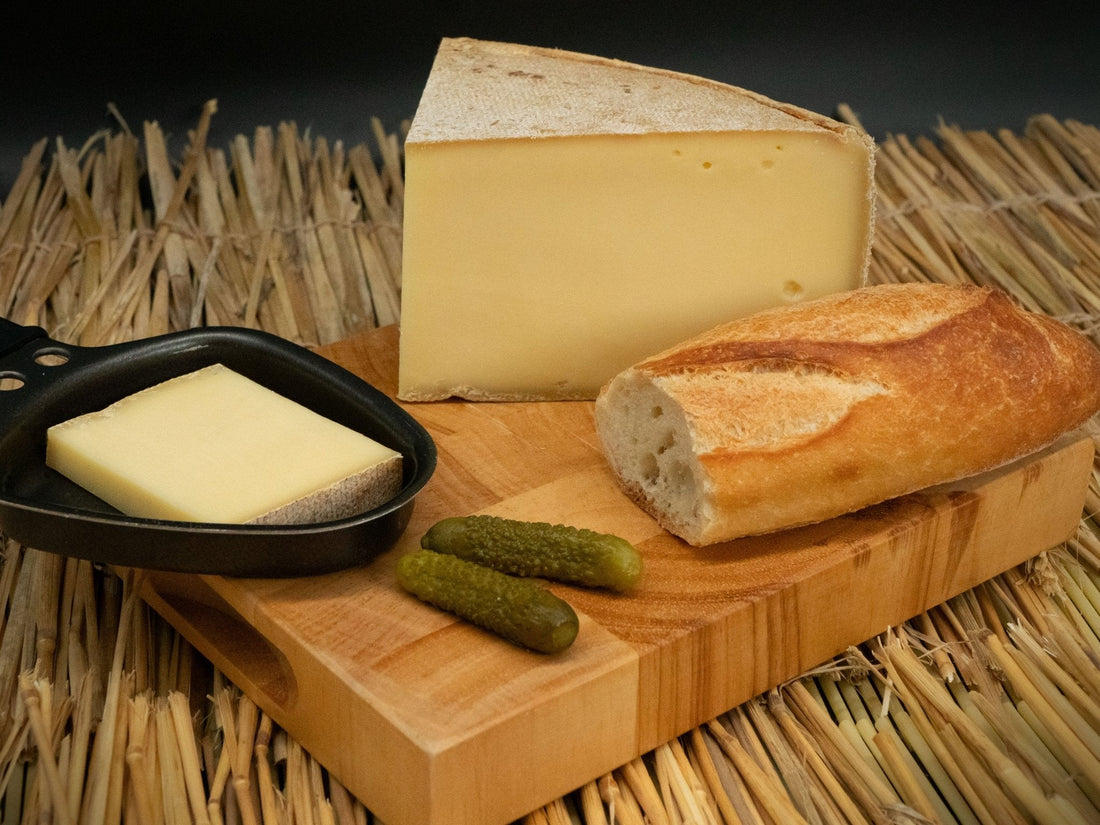
Comté, Beaufort and Abondance for a savoyarde, Gruyère and Vacherin Fribourgeois for a moitié-moitié: the right cheeses, the quantities per person and the techniques that prevent a fondue from splitting or going stringy.
- Savoyarde fondue: Comté, Beaufort and Abondance in equal parts.
- Moitié-moitié fondue: 50% Gruyère, 50% Vacherin Fribourgeois.
- 200 g of cheese per person as a main course, 150 g after a starter, 250 g for big appetites.
- About 10 cl of dry white wine and 100 to 150 g of stale bread per guest, a clove of garlic, a spoonful of cornflour.
- Low heat, never let it boil: stir in a figure of eight, and the cornflour rescues a fondue that is starting to split.
For a savoyarde fondue, take Comté, Beaufort and Abondance in equal parts. For a Swiss moitié-moitié fondue, Gruyère and Vacherin Fribourgeois, half of each. In both cases, allow 200 g of cheese per person (150 g if the fondue follows a starter), about 10 cl of dry white wine per guest, a clove of garlic, a spoonful of cornflour and some stale bread. This guide explains why these particular cheeses, how to measure them out and which techniques prevent a fondue from splitting or going stringy.
Savoyarde fondue: Comté, Beaufort, Abondance
Savoyarde fondue is based on three cooked pressed mountain cheeses, Comté (Jura) and Beaufort and Abondance (French Alps), all made with cow's milk and all with a protected designation of origin. Each brings something different to the caquelon, and it is their balance that makes the fondue.
Comté is the backbone of the blend. A raw milk cheese from the Jura, its smooth paste develops rich aromas and slightly salty notes that deepen over time. For fondue, a Comté 18-23 months is the right compromise: matured enough to have flavour, still supple enough to melt without turning grainy. The deeper Comté 24-29 months lifts the blend if you add a share of it; on its own, a very mature cheese binds poorly.
Beaufort brings the fruitiness. A raw milk pressed cheese from Savoie, it has a unique, fruity flavour with floral notes that vary slightly depending on the season it was made. It is what gives savoyarde fondue its roundness and its mountain aroma.
Abondance provides the suppleness. Its cooked pressed paste, with a slightly fruity flavour and delicate hazelnut notes, has a supple texture that melts easily and smooths the whole. It rounds off the character of the other two.
If you prefer a milder fondue, slightly increase the share of Abondance; for a fruitier one, the Beaufort. All three cheeses are in our selection of cheeses from Savoie.


Moitié-moitié fondue: Gruyère and Vacherin Fribourgeois
Moitié-moitié fondue is the classic recipe from Fribourg: 50% Gruyère, 50% Vacherin Fribourgeois. Both come from the canton of Fribourg, the historic home of Gruyère.
Gruyère PDO is the great hard cheese of French-speaking Switzerland: raw cow's milk, cooked pressed paste, matured for at least five months in a humid cellar. Young, it is mild and fruity; more mature, it becomes bold with hazelnut notes. In fondue, it brings flavour and structure. For a more aromatic version, alpine Gruyère, made only from May to October in mountain chalets with summer milk, gives a more floral, more intense fondue.
Vacherin Fribourgeois PDO is a semi-hard cheese, made only in the canton of Fribourg. Its supple, fine paste melts without stringing or turning grainy: that is precisely why it is essential to a true Swiss fondue. Its round, milky, slightly tangy flavour softens the Gruyère and gives moitié-moitié its characteristic creaminess.
There is also pure Vacherin fondue, the creamiest of all, made over a very low heat and traditionally served with potatoes rather than bread. Do not confuse it with Vacherin from the Jura, a soft cheese in a spruce box: two very different cheeses despite the name.

Other good fondue cheeses
Several other cheeses from our Swiss and Savoyard selection have their place in a caquelon, as a complement.
- Emmentaler: the mildest of the Swiss cheeses, made with raw milk, a supple yet firm paste with a clean, fruity flavour. It softens a blend and appeals to children; on its own, it lacks a little character.
- Appenzeller: a semi-hard raw milk cheese, its rind rubbed with a herbal brine, with a bold, spicy flavour. It adds depth to a moitié-moitié fondue: replace a quarter of the Gruyère with Appenzeller.
- Etivaz: a Swiss alpine cheese, handmade during the summer grazing season, a hard cheese with clean aromas and hazelnut notes. The ancestor of alpine Gruyère, for a festive fondue.
- Tomme de Savoie: a soft texture and fruity flavour. It is not part of a traditional savoyarde fondue, but a small share softens a blend that is too mature.
How much fondue cheese per person?
The rule is the same for savoyarde and moitié-moitié: 200 g of cheese per person as a main course. If the fondue follows a hearty starter, 150 g is enough; for big appetites or an evening that goes on, go up to 250 g. For the wine, allow about 10 cl of dry white wine per person, roughly one bottle for six to seven guests. For the bread, 100 to 150 g per person of day-old bread, cut into cubes with a little crust so it stays on the fork.
| Guests | Cheese (total) | Dry white wine | Stale bread |
|---|---|---|---|
| 2 | 400 g | 20 cl | 200 to 300 g |
| 4 | 800 g | 40 cl | 400 to 600 g |
| 6 | 1.2 kg | 60 cl | 600 to 900 g |
| 8 | 1.6 kg | 80 cl | 800 g to 1.2 kg |
To split it up: for a moitié-moitié for four, that makes 400 g of Gruyère and 400 g of Vacherin Fribourgeois; for a savoyarde for four, about 270 g of each of the three cheeses. Add one clove of garlic per caquelon, one teaspoon of cornflour per 400 g of cheese and, if you like, a small glass of kirsch.
The techniques that make the difference
A failed fondue is rarely down to the cheese, almost always to the temperature or the technique. Here is what we repeat at the counter every winter.
Garlic first. Rub the inside of the caquelon generously with a clove cut in half. You can leave the pieces in the bottom.
Wine before cheese. Heat the dry white wine, without letting it boil, then add the cheese, cut into small dice or coarsely grated, a handful at a time. Each handful should be melted before the next. Cheese at room temperature melts more evenly.
A figure of eight, not a circle. Stir in a figure of eight with a wooden spoon. This movement scrapes the bottom and sides without the cheese sticking.
Cornflour, your insurance. Mix a teaspoon of cornflour with a little cold wine or kirsch and stir it in when the cheese is almost smooth. It stabilises the emulsion and rescues a fondue that is starting to split.
Low heat, never boiling. A fondue that boils separates: the fat rises, the proteins tighten and go stringy. On the table, the burner should keep the fondue barely simmering, no more.
The right maturity. Cheeses that are too young make a bland, elastic fondue that goes stringy; cheeses that are too dry, very long-aged, bind poorly and turn grainy. The ideal blend combines a well-matured cheese for flavour and a more supple cheese for texture: that is exactly what Comté does with Abondance, or Gruyère with Vacherin Fribourgeois.
Kirsch, at the end of cooking. A splash at the last moment, for aroma. Optional: a fondue without wine is perfectly possible (see below).
And Vacherin Mont d'Or? The simplest fondue
For a fondue with no caquelon and no wine to measure, a Vacherin eaten with a spoon is the answer. A soft cheese from the Jura massif, bound with a strip of spruce in its wooden box, it is only made during the cold months. Hot from the oven, it becomes an individual fondue: leave it in its box, score the rind, slip in a clove of garlic and a splash of white wine, and bake for 25 minutes at 200 °C. A 400 to 500 g cheese serves 2 to 3 people as a hot main course, with potatoes and charcuterie. All the steps are in our recipe for baked Mont d'Or. Another Savoyard dish of cheese melted in the oven is berthoud, made with sliced Abondance, garlic and a splash of white wine.

Ordering your fondue cheese
At La Dent du Chat, fondue cheese is cut to order from the wheel, then vacuum-packed. It travels by chilled transport and arrives in 1 to 3 days in Belgium, France and Luxembourg. Gruyère, alpine Gruyère and Appenzeller are available as a block or in slices, from 200 g to 1 kg.
If you are in Brussels, collection is free at our two shops in Ixelles: chaussée de Boondael 430 and place du Châtelain 9. You will find all our cheeses for the caquelon in the raclette and fondue cheeses collection. To round off the evening, see our guide to putting together a cheese platter.
Frequently asked questions
Why does my fondue split or go stringy?
A fondue that splits has been heated too much: the fat separates from the rest. Lower the heat and stir in a teaspoon of cornflour mixed with a little cold wine, stirring in a figure of eight. A stringy fondue usually comes from a cheese that is too young or from a lack of acidity: add a splash of white wine or lemon juice and keep stirring.
Can you prepare fondue the day before?
You can dice or grate the cheese the day before and keep it chilled in a closed box, then take it out an hour beforehand so that it comes back to room temperature. The fondue itself is made at the last moment: reheated, it loses its smoothness. Leftovers, on the other hand, make an excellent gratin or toasted sandwich the next day.
Savoyarde fondue or Swiss fondue: which to choose?
Savoyarde (Comté, Beaufort, Abondance) is fruitier and more aromatic, with the character of the cooked mountain cheeses of the Jura (Comté) and the French Alps (Beaufort, Abondance). Moitié-moitié (Gruyère, Vacherin Fribourgeois) is creamier and milder thanks to the Vacherin Fribourgeois, which melts without stringing. For a first fondue or a table with children, moitié-moitié is the easiest to get right; for lovers of aged cheeses, savoyarde.
Do you deliver fondue cheese to France?
Yes. We ship by chilled transport, vacuum-packed, in 1 to 3 days in Belgium, France and Luxembourg. Collection is free at our two shops in Ixelles, chaussée de Boondael 430 and place du Châtelain 9.
How much cheese for a fondue for 2 people?
Allow 400 g of cheese for two: 200 g of Gruyère and 200 g of Vacherin Fribourgeois for a moitié-moitié, or about 135 g each of Comté, Beaufort and Abondance for a savoyarde. Add 20 cl of dry white wine and 200 to 300 g of stale bread.
Can you make fondue without white wine?
Yes. Replace the wine with the same quantity of light vegetable stock, dry cider or unsweetened apple juice cut with water, with a dash of lemon juice: it is the acidity that helps the cheese bind. Use a little more cornflour to stabilise the mixture.
Your fondue cheese, cut from the wheel
Comté, Beaufort, Abondance, Gruyère and Vacherin Fribourgeois, cut to order and delivered vacuum-packed by chilled transport in 1 to 3 days in Belgium, France and Luxembourg. Free collection at our two shops in Ixelles.