
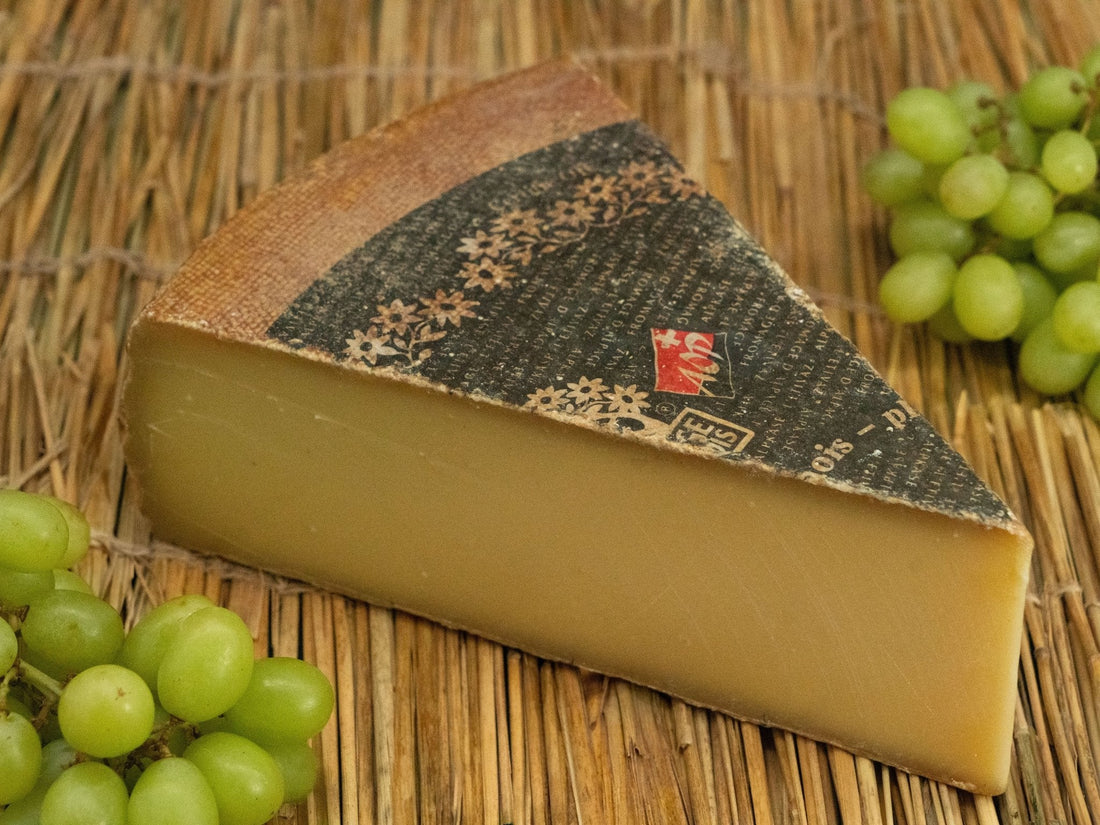
Gruyère, Appenzeller, Tête de Moine, Emmentaler, Vacherin Fribourgeois: each Swiss cheese has its own technique and its own use. Here is how to recognise them, which one to choose for fondue, raclette or a cheese platter, and how we recommend them at the counter in Ixelles.
- Gruyère AOP has no holes; it is Emmentaler that has them. Gruyère is the backbone of fondue, Emmentaler the mildest of the Swiss cheeses.
- For moitié-moitié fondue: 50% Gruyère, 50% Vacherin Fribourgeois, 200 g per person.
- For raclette: Swiss mountain raclette matured for 3 months, 200 to 250 g per person.
- For a cheese platter: a Tête de Moine on its girolle, an Appenzeller for character, a Gruyère d'alpage or an Etivaz for depth.
- Almost all are pressed cheeses made from raw cow's milk, which keep for 2 to 3 weeks in the fridge and travel very well vacuum-packed.
Switzerland is a land of pressed cheeses: mountain cow's milk, cooked and pressed wheels, long maturing in the cellar. That is what Swiss cheeses have in common, a firm paste that melts well and keeps for a long time, and it is also what sets them apart from one another: the time in the cellar, whether or not the rind is rubbed, the altitude of the pastures. In our selection of Swiss cheeses, each one has its place: some are made for the caquelon, others for the girolle, others still to finish a cheese platter. Here is the overview.
Swiss cheeses at a glance
| Cheese | Milk and paste | Maturing | Best use |
|---|---|---|---|
| Gruyère AOP | Cow, raw milk, cooked pressed | 5 months minimum | Fondue, gratin, cheese platter |
| Gruyère d'alpage AOP | Cow, raw alpine pasture milk, cooked pressed | Made from May to October | Festive cheese platter, fragrant fondue |
| Emmentaler | Cow, raw milk, cooked pressed, with holes | Young | Toasties, gratin, children |
| Appenzeller | Cow, raw milk, semi-hard, rind rubbed with herbs | 3 months minimum | End of the platter, toasties, burgers |
| Tête de Moine AOP | Cow, raw milk, semi-hard | 4 to 6 months | Rosettes on the girolle, aperitif |
| Vacherin Fribourgeois AOP | Cow, semi-hard | Young to matured | Moitié-moitié fondue, pure Vacherin fondue |
| L'Etivaz | Cow, hard alpine pasture cheese | Made during the summer grazing season | Cheese platter, aperitif in thin slivers |
| Swiss mountain raclette | Cow, semi-hard, washed rind | 3 months minimum | Raclette |
Gruyère AOP, the backbone
Gruyère AOP is the great hard cheese of French-speaking Switzerland. Raw cow's milk, cooked pressed cheese, matured for at least five months in a humid cellar where the wheels are turned and rubbed with brine. The specification is strict: milk from nearby farms, no additives, production in the cantons of Fribourg, Vaud, Neuchâtel and Jura. Ours comes from the Fribourg region, the historic home of Gruyère.
Young, it is mild and fruity; more matured, it becomes full-flavoured, with crunchy crystals and notes of hazelnut. It is the all-rounder of Swiss cooking: grated over a gratin, an onion soup or a croque-monsieur, thinly sliced on a cheese platter with walnut bread, and above all in fondue, on its own or moitié-moitié with Vacherin Fribourgeois.
Two variants are well worth trying. Gruyère d'alpage AOP is the summer Gruyère: made only from May to October in mountain chalets, often over a wood fire in a copper cauldron, with the raw milk of cows grazing at altitude. The mountain herbs and flowers pass into the milk, then into the paste: the flavour is more floral, longer and more intense. Gruyère d'exception 15 months is a reserve Gruyère: a firm, slightly grainy paste, dotted with tyrosine crystals, with aromas of toasted hazelnut, dry hay and cellar. For a festive cheese platter or a top-of-the-range fondue.

Emmentaler, the mild one with holes
It is the cheese everyone pictures when you say "Swiss cheese", and it is this one, not Gruyère, that has the holes. Emmentaler is made from raw milk in the Bern region; its paste is both supple and firm, its flavour clean and fruity, and it is the mildest of all Swiss cheeses. Children love it, it melts beautifully on a toastie or in a gratin, and it softens a fondue mix that is too strong. To compare it with other melting cheeses, see our guide which cheese for a croque-monsieur or a burger.
Appenzeller and Le Maréchal: herb-rubbed rinds
Appenzeller is the most fragrant of the semi-hard Swiss cheeses. Made for more than 700 years in north-eastern Switzerland, around the cantons of Appenzell and St Gallen, it owes its character to its rind, which is rubbed during maturing with a herbal brine, the Sulz, whose recipe is kept secret. The paste stays supple and golden, the flavour is full, spicy, and grows stronger with age: three months for a mild, fruity cheese, six months and more for a sharp paste with emerging crystals. It is served at the end of the cheese platter, after the milder cheeses, and adds depth to a moitié-moitié fondue if you replace a quarter of the Gruyère with Appenzeller.
Le Maréchal plays in the same register with a different technique: the rind of this artisanal hard cheese is rubbed with dried herbs throughout its four months of maturing. The herbs flavour the paste from the outside in; the taste is spicy, powerful and herbaceous, while the paste stays melting. Melted into a fondue, it brings a herbal note in place of garlic.
Tête de Moine, the cheese you scrape
Tête de Moine AOP is not cut, it is scraped: placed on a girolle, the cylindrical wheel turns into fine, airy rosettes that release all their fragrance. It was born more than 800 years ago at Bellelay Abbey, in the Bernese Jura, where the monks were already making it. A semi-hard raw cow's milk cheese with a bold, fruity, slightly spicy flavour; the AOP requires a minimum of two and a half months' maturing, and ours is matured for 4 to 6 months for more character.
On a cheese platter, the girolle always makes an impression, and children love turning the handle. As an aperitif, serve the rosettes with grapes or walnuts; on a salad or a risotto, as shavings added at the last moment. No girolle? A thin-bladed knife will let you lift shavings, after removing the rind from the top. We offer it from 200 g to 1 kg.

Vacherin Fribourgeois, the fondue cheese
Vacherin Fribourgeois AOP is a semi-hard cow's milk cheese, made only in the canton of Fribourg. Its supple, fine paste melts without stringing or turning grainy: that is precisely why it is essential to a genuine Swiss fondue. Moitié-moitié, the benchmark Fribourg recipe, combines 50% Gruyère and 50% Vacherin Fribourgeois; pure Vacherin fondue, the creamiest of all, is made over a very low heat and traditionally served with potatoes. On its own, it offers a round, milky, slightly tangy flavour, with hazelnut notes that grow stronger with maturing. The proportions and techniques are in our guide which cheese for fondue.
Do not confuse it with spoonable Vacherin, Mont d'Or: a runny soft cheese from the Jura mountains, bound with spruce bark in its wooden box, eaten with a spoon or hot from the oven. Two very different cheeses despite the name.
Long-keeping hard cheeses: Etivaz, Schürchäs, Schlossberger, Bémontois
Alongside the great appellations, Switzerland produces long-matured hard mountain cheeses, often artisanal, which we like to place at the end of a cheese platter.
- L'Etivaz: an alpine pasture cheese made by hand, in small quantities, exclusively during the summer grazing season, with milk from the mountain pastures. A hard paste, clean aromas, fruity notes and a light hint of hazelnut. It is the forerunner of Gruyère d'alpage.
- Schürchäs Sénior: a cheese from the Bern region matured for a year. A dense paste studded with crystals that crunch between the teeth, a rich flavour with notes of walnut and brown butter. Better broken into chunks than sliced.
- Schlossberger: matured for 18 months, a rich and slightly grainy texture, small protein crystals. Somewhere between the taste of a Gruyère and that of a Comté.
- Le Bémontois: matured for three months, a surprisingly creamy hard cheese, fine and mild, slightly salty, with hazelnut aromas and a fruity touch reminiscent of pineapple. The mild hard cheese to serve before the stronger ones.
Swiss raclette and viande des Grisons
Raclette was born in Switzerland, in Valais. Our Swiss mountain raclette, with a washed rind and matured for at least 3 months, is a rich, supple raclette cheese with a full flavour, which coats the potato without stringing or releasing oil. Quantities, formats and a comparison with Savoie raclette: it is all in our guide to raclette cheese. The classic accompaniment in Switzerland is viande des Grisons, beef air-dried in the canton of Graubünden under PGI, whose story you can read in our article viande des Grisons.
Building a 100% Swiss cheese platter
The method is the same as for any cheese platter, one family per cheese, and Switzerland lets you follow it without leaving the country:
- A mild hard cheese to open: Le Bémontois or an Emmentaler.
- A semi-hard cheese: Vacherin Fribourgeois, in pieces, with walnut bread.
- A showpiece: Tête de Moine on its girolle.
- A long-matured cheese: Gruyère d'alpage, Etivaz or Schürchäs Sénior.
- A cheese with character to finish: Appenzeller or Le Maréchal.
Allow 150 to 200 g per person if the platter ends the meal, 80 to 100 g as an aperitif. For quantities by number of guests and tasting order, see how to put together a cheese platter. In the glass, a dry, structured white, a Swiss wine or a Savoie wine, suits almost all of them; an amber beer goes very well with Le Maréchal and Schürchäs.
Frequently asked questions
What is the best-known Swiss cheese?
Gruyère AOP and Emmentaler share the fame. Gruyère is the backbone of fondue and Swiss cooking; Emmentaler, with its holes, is the one people picture when you say "Swiss cheese". Then come Appenzeller, Tête de Moine and raclette.
Does Gruyère have holes?
No. Gruyère AOP has a solid paste, sometimes marked with fine cracks. It is Emmentaler that has large round holes. Both are cooked pressed cheeses made from raw cow's milk, but Gruyère is more matured and fuller in flavour, Emmentaler milder.
Which Swiss cheese for fondue?
Moitié-moitié fondue, the benchmark Fribourg recipe: 50% Gruyère AOP and 50% Vacherin Fribourgeois AOP, 200 g of cheese per person. For a more fragrant version, use Gruyère d'alpage; for more depth, replace a quarter of the Gruyère with Appenzeller. The details are in our guide which cheese for fondue.
Which Swiss cheese for raclette?
Swiss mountain raclette, matured for at least 3 months: rich, supple and full-flavoured, it melts without stringing or releasing oil. Allow 200 to 250 g per person, sliced for a raclette grill with pans or as a half-wheel for traditional raclette.
How do you serve Tête de Moine without a girolle?
Remove the rind from the top, then lift thin shavings with a thin-bladed knife, working your way round the wheel. The rosettes will be less even than with a girolle, but the fragrance is the same. The girolle remains the ideal tool, and the gesture always goes down well at the table.
Do you deliver Swiss cheeses to France?
Yes. We ship vacuum-packed, chilled, in 1 to 3 days on average to Belgium, France and Luxembourg. Collection is free from our two shops in Ixelles, chaussée de Boondael 430 and place du Châtelain 9.
Our Swiss cheeses, cut to order
Gruyère AOP, Appenzeller, Tête de Moine, Vacherin Fribourgeois, Etivaz and Swiss mountain raclette, vacuum-packed and delivered in 1 to 3 days in Belgium, France and Luxembourg. Free collection from our two shops in Ixelles.