
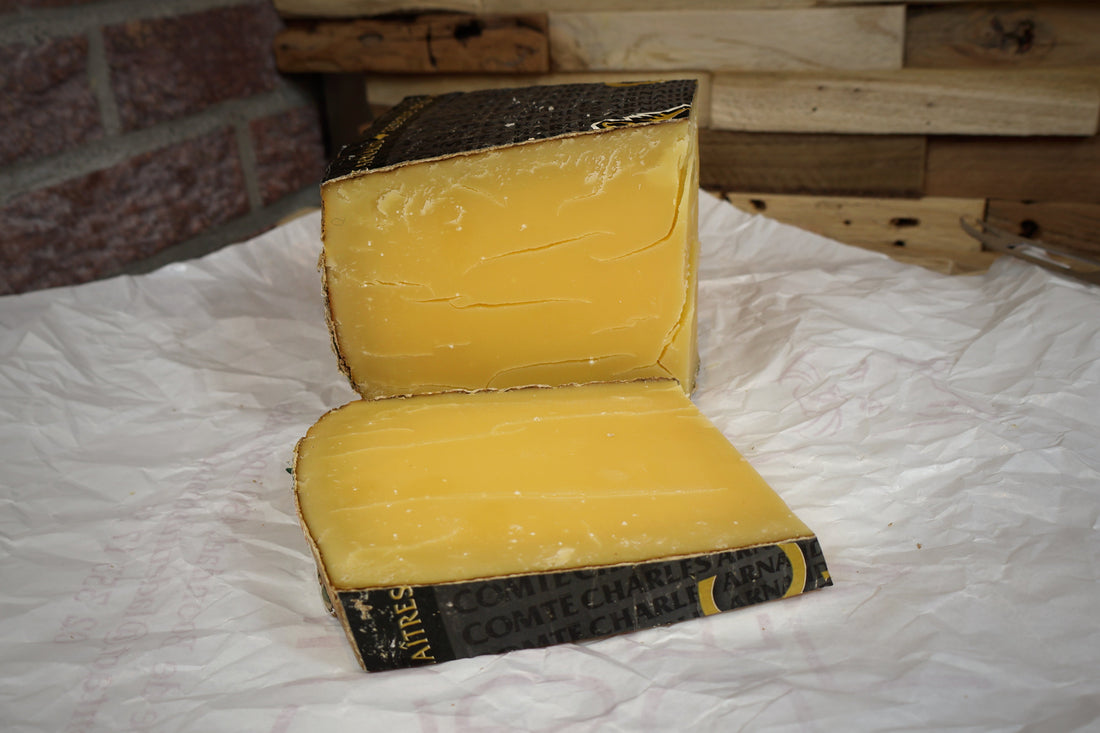
Comté, Beaufort, Gruyère on one side; tomme de Savoie, Reblochon, Saint-Nectaire, Cantal on the other. All are pressed cheeses, but some are cooked and others are not. Here is what that changes in the wheel, on the plate and when it comes to choosing, just as we explain it at the counter in Ixelles.
- Cooked pressed cheese: the curd is heated before pressing. Large wheels, long maturing, hard cheese and crystals: Comté, Beaufort, Gruyère, Parmigiano Reggiano, Emmentaler.
- Uncooked pressed cheese: the curd is pressed without heating. Smaller wheels, shorter maturing, supple cheese: tommes, Reblochon, Saint-Nectaire, Cantal, Morbier, raclette, gouda, cheddar.
- For fondue, the cooked ones; for raclette and tartiflette, the uncooked ones; for grating, the most mature of both.
- Pressed cheeses keep for 2 to 3 weeks in the fridge and travel very well vacuum-packed.
On a cheese platter, people often talk about “hard” and “semi-hard” cheese, but the cheesemakers' classification is more precise: behind a Comté and a tomme de Savoie lies the same starting point, curdling the milk then pressing the curd to drive out the whey, and one decisive difference, cooking the curd. That is what separates the two great families of pressed cheese, and why a Beaufort keeps for months while a Reblochon is eaten within a few weeks. Here is how to recognise and use them.
Cooked or uncooked pressed cheese: the difference
In both cases, rennet is added to the milk, the curd is cut then stirred, and the cheese is moulded and pressed. The difference lies in one step:
- Cooked pressed cheese. Before moulding, the curd is heated in the vat to above 50 °C while being stirred. The curd grains tighten and lose a lot of water: the resulting cheese is dry and dense, and can take very long maturing, from several months to several years. This is the family of the great mountain wheels, born of the need to keep summer milk for the winter: Comté, Beaufort, Abondance, Gruyère, Emmentaler, Parmigiano Reggiano.
- Uncooked pressed cheese. The curd is pressed without being heated. The cheese holds more moisture: it is more supple, matured for a shorter time, from a few weeks to a few months, and the wheels are smaller. This is the family of tommes and farmhouse cheeses: tomme de Savoie, Reblochon, Saint-Nectaire, Cantal, Morbier, raclette, but also gouda, mimolette, cheddar and manchego.
One nuance: “hard cheese” and “cooked pressed cheese” are not synonyms. A 12-month aged gouda or a 22-month mimolette are uncooked pressed cheeses that have become very hard with age, to the point of developing crystals. The reverse also exists: a young Comté stays supple. Cooking describes how the cheese is made; hardness describes how it has matured.
Pressed cheeses at a glance
| Cheese | Family | Milk | Maturing | Best use |
|---|---|---|---|---|
| Comté | Cooked pressed | Cow's milk, Jura | 12 to 36 months depending on the selection | Cheese platter, fondue, grated |
| Beaufort | Cooked pressed | Cow's milk, raw milk, Savoie | Several months | Savoyarde fondue, cheese platter |
| Abondance | Cooked pressed | Cow's milk, French Alps | Artisan | Fondue, cheese platter, aperitif |
| Gruyère AOP | Cooked pressed | Cow's milk, raw milk, Switzerland | 5 months minimum | Moitié-moitié fondue, gratin |
| Parmigiano Reggiano | Cooked pressed | Cow's milk, raw milk, Emilia-Romagna | 12 to 36 months | Grated, in shards |
| Tomme de Savoie | Uncooked pressed | Cow's milk, Savoie | A few weeks to 3 months | Cheese platter, snack, sandwich |
| Reblochon | Uncooked pressed | Cow's milk, Savoie | Short | Tartiflette, cheese platter |
| Saint-Nectaire AOP | Uncooked pressed | Cow's milk, Auvergne | 28 days minimum, 6 to 8 weeks here | Cheese platter |
| Cantal Salers | Uncooked pressed | Cow's milk, Auvergne | Thick rind, matured | Cheese platter, cooking |
| Morbier | Uncooked pressed | Cow's milk, raw milk, Jura | Short | Cheese platter, morbiflette |
| Raclette | Uncooked pressed | Cow's milk, Savoie or Switzerland | 3 months for the Swiss one | Raclette |
| Aged gouda, Mimolette 22 months | Uncooked pressed, long-aged | Cow's milk | 12 to 22 months | Aperitif shards, grated |
Cooked pressed cheeses: the great mountain wheels
Comté is the archetype. A cow's milk cheese from the Jura, it develops rich aromas and slightly salty notes over a patient maturing, growing fuller with time. We offer it at four ages: 12-17 months, supple and fruity, the everyday cheese; 18-23 months, the right compromise for fondue; 24-29 months, deeper, for the cheese platter; and the Comté millésimé 36 months, three winters and three summers in the cellar, where tyrosine crystals appear in abundance. With a Jura vin jaune, it is the classic pairing.
Beaufort is its cousin from Savoie, made with raw milk: a unique, fruity flavour with floral notes, whose aromas vary slightly with the season it was made in. Abondance, made from the milk of the French Alps, has a slightly fruity taste, delicate hazelnut notes and a supple texture that melts easily. These three, in equal parts, make the Savoyarde fondue; the details are in our guide which cheese for fondue, and all of them are in our collection of cheeses from Savoie.

On the Swiss side, Gruyère AOP, raw milk, matured for at least five months, is the mainstay of the moitié-moitié fondue; Emmentaler, the mildest, is the one with the holes. We cover them, along with Etivaz and the hard keeping cheeses, in our guide which Swiss cheese for which use. On the Italian side, Parmigiano Reggiano 12 months is the cooking parmesan, still supple, which melts into a risotto without dominating; the 36 months is the one for tasting, dry, crumbly, studded with crystals, with a long finish between stock, walnut and dried fruit.
Uncooked pressed cheeses: tommes, Reblochon, Saint-Nectaire, Cantal
Tomme de Savoie is the emblem of the family: a supple cheese under a grey, rustic rind, a soft texture and a fruity flavour. It comes in very different characters. Tomme de montagne, made at altitude, is bolder, frank, slightly tangy, with hints of fresh grass and hazelnut. Tomme crayeuse is like no other: after about six weeks of maturing, the cheese is melting at the edges and chalky at the heart, two textures in the same slice, with citrus notes. The creamy tomme de Yenne, made at the foot of the Dent du Chat, the mountain that gave our cheese shop its name, favours melting softness over firmness. And the flavoured tommes, with wild garlic or with truffle, show how well this supple cheese takes on aromatics.
Reblochon, the first cheese from Savoie to obtain AOC status, in 1958, takes suppleness further: a fine, smooth cheese, herbaceous aromas and a pronounced cellar smell. It is the cheese for tartiflette, and it melts so well that it is sometimes wrongly classed among the soft cheeses.

In Auvergne, two great classics. Saint-Nectaire AOP, made in the Monts Dore from the milk of cows grazing volcanic pastures, is matured for at least 28 days, 6 to 8 weeks for our selection, in a humid cellar where the rind becomes covered with natural grey and pink moulds: the cheese is very melting, with a taste of hazelnut, cellar and earth. Cantal Salers, one of the oldest French cheeses, produced for more than 2,000 years, has a thick rind and develops a cheese that is both firm and supple, with aromas of fresh undergrowth and tall broom. In the Jura, raw milk Morbier is recognisable by its horizontal line of vegetable charcoal: a fine, smooth cheese, a melting, slightly sticky texture, with notes of milk, caramel, vanilla and fruit.
Outside France, the family is just as broad: aged gouda, at least 12 months in the cellar, with a dry, brittle texture studded with crystals; Mimolette 22 months, the Boule de Lille taken to its limit, bright orange, with notes of hazelnut and caramel; Cheddar Farmhouse, matured for about 9 months, firm and smooth; Manchego 12 months, the great Spanish sheep's milk cheese from La Mancha, hard and firm.
How to tell them apart by eye and on the palate
- The size of the wheel. Cooked pressed cheeses are large wheels, 30 to 40 kg for a Comté or a Gruyère; uncooked ones weigh a few kilos, or even come in 500 g formats for a Reblochon.
- The rind. Smooth, hard, brushed or rubbed with brine for the cooked ones; grey, bloomy, often irregular for the tommes and Saint-Nectaire, which develop their natural moulds in the cellar.
- The cheese. Dense, ivory to straw yellow, sometimes studded with crystals for the aged cooked ones; supple, elastic, sometimes with small holes for the uncooked ones. Emmentaler's large round holes are the exception among the cooked ones.
- The flavour. Cooked ones develop aromas of hazelnut, browned butter and dried fruit, with a finish that lengthens with maturing; uncooked ones keep more milky, herbaceous notes, of cellar and mushroom, and a more melting texture.
Which one to choose, and for what?
For fondue, cooked pressed cheeses: they melt into a smooth, fragrant mixture. Comté, Beaufort and Abondance for the Savoyarde; Gruyère and Vacherin Fribourgeois for the moitié-moitié. Allow 200 g per person.
For raclette, tartiflette and gratins, uncooked pressed cheeses, more supple and richer: they flow without stringing. Raclette cheese, of course, covered in our guide raclette cheese and in our collection raclette and fondue cheese; Reblochon for tartiflette, Morbier for morbiflette, a creamy tomme de Yenne in place of Reblochon.
For grating, the most mature of both families: Parmigiano Reggiano, Comté 24-29 months, Gruyère, aged gouda, mimolette 22 months. The drier the cheese, the finer it grates and the more flavour it gives a dish with very little cheese.
For the cheese platter, take one from each family, and serve the uncooked before the cooked: a tomme or a Saint-Nectaire first, a matured Comté or a Beaufort next, because the aromas grow stronger with maturing. Take them out 30 minutes before serving. For the full order and quantities, see how to put together a cheese platter.
Storing a pressed cheese
Pressed cheeses are the easiest cheeses to keep. In the fridge, in the vegetable drawer, in their original paper or vacuum-packed, they keep for 2 to 3 weeks; the long-aged ones, Comté 36 months, Parmigiano Reggiano, aged gouda, last several weeks vacuum-packed. Once the pack is open, wrap the piece in its paper and eat it within two weeks. A piece that has dried on the surface grates very well into a gratin. We ship them vacuum-packed, chilled, in 1 to 3 days on average to Belgium, France and Luxembourg; collection is free at our two shops in Ixelles, chaussée de Boondael 430 and place du Châtelain 9.
Frequently asked questions
What is the difference between cooked and uncooked pressed cheese?
Heating the curd. For a cooked pressed cheese, the curd is heated above 50 °C before pressing: the cheese is drier, the wheels larger and the maturing longer (Comté, Beaufort, Gruyère, Parmigiano Reggiano). For an uncooked pressed cheese, the curd is pressed without heating: the cheese stays more supple and matures for less time (tomme de Savoie, Reblochon, Saint-Nectaire, Cantal, Morbier, raclette, gouda).
Is Comté a cooked pressed cheese?
Yes. Comté is the textbook example of a cooked pressed cheese, like Beaufort, Abondance, Gruyère, Emmentaler and Parmigiano Reggiano. That is what allows it to be matured for 12 to 36 months and more.
Pressed cheese, hard cheese, semi-hard cheese: are they the same thing?
Not quite. “Cooked” and “uncooked pressed cheese” describe how it is made; “hard” and “semi-hard” describe the texture, which depends mainly on maturing. An aged gouda is an uncooked pressed cheese that has become very hard; a young Comté is a cooked pressed cheese that is still supple.
Which pressed cheeses are best for grating?
The most mature: Parmigiano Reggiano 36 months, Comté 24-29 months, Gruyère, aged gouda, Mimolette 22 months. The drier the cheese, the finer it grates and the more flavour it gives a dish with very little cheese.
Can you eat the rind of pressed cheeses?
The rind of cooked pressed cheeses (Comté, Gruyère, Parmigiano) is hard and brushed: you do not eat it, but it flavours a stock or a soup. The bloomy rind of tommes and Saint-Nectaire can be eaten if you like it; the washed rind of raclette grills very well under the pan. Remove it if it seems too thick or too strong.
Do you deliver pressed cheeses to France?
Yes. We ship vacuum-packed, chilled, in 1 to 3 days on average to Belgium, France and Luxembourg. Collection is free at our two shops in Ixelles, chaussée de Boondael 430 and place du Châtelain 9.
Our pressed cheeses, cut to order
Comté, Beaufort, Abondance, tommes de Savoie, Reblochon, Saint-Nectaire, Cantal and Gruyère, cut from the wheel and delivered vacuum-packed in 1 to 3 days in Belgium, France and Luxembourg. Free collection at our two shops in Ixelles.